Right now, for the first time, we all have FREE online access to RootsTech. In 2021 this huge genealogy event is completely free, and it's 'virtual' (everything is online). The video presentations by more than a hundred speakers cover a wide range of topics. Register now, and watch the videos up to to a year later at a time that suits you.
The 'main stage' events don't really interest me, so I went straight to 'Sessions'. Here's a list of people whose presentations I'm likely to watch. In most cases I've previously heard them speak and was favourably impressed. Each link opens in a new window, and the page will show all the sessions being presented by that speaker.
AUSTRALIAN or NEW ZEALAND research
Heather Garnsey
Shauna Hicks
Fiona Brooker
BRITISH research
Else Churchill
Nick Barratt
Jackie Depelle (a 'must-see' if you have Yorkshire ancestry)
Celia Heritage
Myko Clelland
Caroline Gurney
Simon Fowler
Sylvia Valentine
Amy Harris
VARIOUS topics
Judy G. Russell
Thomas MacEntee
Dan Poffenberger
Susia Zada
D. Joshua Taylor
Jenny Joyce
Carol Baxter
Thomas Wright Jones
Amy Johnson Crow
DNA
Diahan Southard
Roberta J. Estes
Debbie Kennett
Kitty Cooper
Maurice Gleeson
WARNINGS
(1) If you want to check whether another speaker is taking part, search for his/her surname on the Speakers page (not in 'Search by title, speaker or topic' on the main search screen, because it fails to find some speakers).
(2) Don't spend too much time (if any) on the 'Relatives at RootsTech' section of the site. Judy Russell explains why in About those Relatives at Rootstech...
(This post first appeared on https://genie-leftovers.blogspot.com/2021/02/free-online-genealogy-conference.html.)
Information for family historians worldwide, including Australia, UK, Ireland, USA, Canada, New Zealand, Europe, South Africa etc. There are also links to my locality-specific genealogy blogs. Explore all the options in the tabs below, in the sidebar and at the bottom of the page, and on my main Web site.
Showing posts with label DNA. Show all posts
25 February 2021
29 July 2020
How to Keep AncestryDNA's Small-Segment Matches
From late August 2020, AncestryDNA will delete matches who share less than 8 cM with you - unless you have added a note about them, added them to a custom group, or messaged them. Some of my known relatives only share 6 cM or 7 cM with me, and I'm sure there are others whom I haven't identified yet. Here is my strategy to prevent those people from disappearing.
#1. In my AncestryDNA account, I created a custom group called '6-8cM Keep' (but you could skip this step and just add a Note to matches you want to keep).
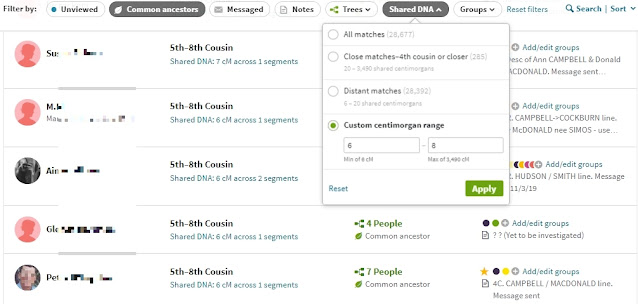
#2. In the 'Shared DNA' filter, I select 'Custom centimorgan range' and set it to min=6 and max=8; then I do a series of searches, and on the results screen I either add a Note or assign people to my group '6-8cM Keep'. Examples of searches (with 'Custom centimorgan range' set to min=6 & max=8):
#3. Filter for 'Common ancestor'. (Some of the 'potential ancestors' will be wrong, because Ancestry's Thrulines derives those ancestor predictions from other people's trees, many of which are wrong - but I need to prevent those matches from disappearing so that I can later check the Thrulines theory.)
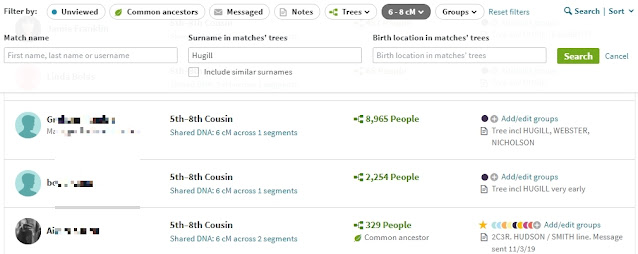
#4. Using 'Surnames in matches' trees', I do a series of searches for end-of-line ancestors' surnames, 'brick wall' surnames, unusual surnames, etc.
#5. Using 'Birth location in matches' trees', I do a series of searches for the main places where my families lived. I've also done some combined surname + birthplace searches, eg: "Surname in matches' trees" = CAMPBELL, combined with "Birth location" = Argyll, Scotland. (CAMPBELL is so common that I don't want to keep all the matches, but some small-segment matches with CAMPBELL ancestors in Argyllshire will be my relatives.)
How close is an 8 cM match? In some cases it will be closer than a 4th cousin. To see the full list of possible relationships, with probabilities for each, enter '8' in the interactive Shared Centimorgan Project tool.
* Roberta ESTES explains a more thorough strategy for preserving small-segment matches that may be useful.
* Blaine BETTINGER explains why many small segments are *not* valid shared DNA.
* My personal thoughts on using DNA as a tool for family history.
(This post first appeared on https://genie-leftovers.blogspot.com/2020/07/how-to-keep-ancestrydnas-small-segment.html.)
#1. In my AncestryDNA account, I created a custom group called '6-8cM Keep' (but you could skip this step and just add a Note to matches you want to keep).
#2. In the 'Shared DNA' filter, I select 'Custom centimorgan range' and set it to min=6 and max=8; then I do a series of searches, and on the results screen I either add a Note or assign people to my group '6-8cM Keep'. Examples of searches (with 'Custom centimorgan range' set to min=6 & max=8):
#3. Filter for 'Common ancestor'. (Some of the 'potential ancestors' will be wrong, because Ancestry's Thrulines derives those ancestor predictions from other people's trees, many of which are wrong - but I need to prevent those matches from disappearing so that I can later check the Thrulines theory.)
#4. Using 'Surnames in matches' trees', I do a series of searches for end-of-line ancestors' surnames, 'brick wall' surnames, unusual surnames, etc.
#5. Using 'Birth location in matches' trees', I do a series of searches for the main places where my families lived. I've also done some combined surname + birthplace searches, eg: "Surname in matches' trees" = CAMPBELL, combined with "Birth location" = Argyll, Scotland. (CAMPBELL is so common that I don't want to keep all the matches, but some small-segment matches with CAMPBELL ancestors in Argyllshire will be my relatives.)
How close is an 8 cM match? In some cases it will be closer than a 4th cousin. To see the full list of possible relationships, with probabilities for each, enter '8' in the interactive Shared Centimorgan Project tool.
* Roberta ESTES explains a more thorough strategy for preserving small-segment matches that may be useful.
* Blaine BETTINGER explains why many small segments are *not* valid shared DNA.
* My personal thoughts on using DNA as a tool for family history.
(This post first appeared on https://genie-leftovers.blogspot.com/2020/07/how-to-keep-ancestrydnas-small-segment.html.)
14 January 2014
Genealogy in 2013 - Accentuate the Positive
My response to the latest 'Accentuate the Positive' geneameme will be shorter than most. During 2013 I chose to spend more time with my nearest and dearest, and less time doing my own family history. I also began to change the focus of my work as a genealogy professional. Noteworthy events during 2013 included:
I wonder what 2014 will bring!
~~~
- After many months of hard work, I finally finished revamping, expanding and moving my main Web site. All 135 pages are now at www.judywebster.com.au (my own domain name). The site has advice and indexes that help genealogists to research local, interstate and overseas folk by using historical records. The emphasis is on unusual sources that are superb for problem solving. (Read about the features of the new site.)
- More than 16,000 names from three of my indexes (hospital admission records for Croydon and Brisbane, and old age pension records) were added to the Australasian collection at FindMyPast.
- I had an article published in Inside History magazine ('The Case of the False Identity'). To the amazement and delight of one reader, an example I quoted in my article revealed that her great-grandfather was one of several people who used someone else's identity to emigrate to Australia.
- Statistics showed that there was an exceptionally good response to two of my blog posts, Tips on Using FindMyPast for Genealogy and Improved Searches for Births Deaths and Marriages.
- I created a Web page with a reading list to highlight some of my favourite books plus others that I want to read during the coming year. The list includes genealogy, history and fiction titles.
- In addition to my usual genealogy talks, I experimented with private face-to-face consultations and informal group sessions (which, thankfully, were a great success).
- I started using DNA testing for genealogy.
- I visited relatives in outback Queensland, and my cousin let me copy family photographs and WW2 letters that I had never seen.
I wonder what 2014 will bring!
~~~
05 January 2013
Update on my family's DNA Testing
Last month I wrote about my plans to use DNA testing as a genealogy tool. Kerry Farmer subsequently reminded me of two important points that I forgot to mention (see Postscript no.1 on 'DNA Testing for My Family History').
My uncle's autosomal DNA ('Family Finder') test results have arrived! He already has six matches in the '2nd-4th cousin' predicted range and ten in '3rd-5th cousin'. I am hoping for closer matches in the future when more genealogists with known English and Scottish ancestry do tests through FamilyTreeDNA. I am also hoping that some of my second-cousins will agree be tested.
The best match so far is 'shared cM 49.22, longest block 32.05'... but I have not yet learned how to interpret all this. I was not expecting the test results until mid-January, so I got caught short and hadn't done my homework!
I have already started contacting people who match my uncle's autosomal DNA. I soon realised that I need to send them a list of all names (except living people), not just a pedigree chart - because the name they might recognise won't necessarily be my direct ancestor. As Gedmatch points out, "siblings (and descendants of siblings) of one family often turn up as 'spouses' (with no recorded ancestors) in another family." There is a diagram that illustrates this clearly.
If you have advice to share with DNA newbies like myself, please add a comment below. It will be very welcome.
03 December 2012
DNA Testing for my Family History
I am using a new tool for genealogy - DNA testing! It can show ethnic origins, confirm relationships (or prove that two people cannot be related), and put family historians in contact with others who share the same ancestry.
My 91-year-old uncle agreed to be tested, so I took advantage of the sale at Family Tree DNA, an established, respected company recommended by genealogists who are experts in this field. Family Tree DNA will match my uncle's test results against their database (the largest of its kind in the world) and let me contact anyone whose results show that they are somehow related to us. The database is growing rapidly as more people are tested, so I log in regularly to check for new matches.
I started by ordering the FamilyFinder test, which uses autosomal DNA inherited from mother, father, four grandparents, eight great-grandparents, etc. This has the potential to identify descendants of any ancestral lines within about the last six generations. Those descendants may have vital information, or photographs or letters from my direct ancestors.
I am a great believer in researching all siblings. Some of my most exciting discoveries were a direct result of contacting distant cousins. The image above shows part of a family document held by Joe HUDSON. It confirmed that a baptism I'd found was for the right William HUDSON. (The baptism register for Bossall, North Yorkshire, gave a birth date and named the child's maternal grandparents!) Joe also sent me a copy of a letter written in 1879 by my great-great-grandfather.
The FamilyFinder autosomal DNA test is available to men and women, so I could have been tested myself. However it made more sense to test my uncle (my late father's only surviving sibling) because I am currently more interested in my father's ancestors than my mother's. The autosomal test may help me to confirm and expand the paper trail for various families including BUTLER, CAMPBELL, GIBLETT, HARLEY, NICHOLSON, PORTER and SHEPPARD (on the WEBSTER side) and AGAR, ASHTON, BARBER, BIRKS, CLARK, HUGILL, MATTHEW and PEACOCK (on the HUDSON side).
Our FamilyFinder test results arrived just before Christmas. My budget for genealogy is limited, so I am hoping that interested relatives will contribute a small sum towards the cost of ordering two additional tests. A mitochondrial DNA test could get us back beyond Mary PEACOCK nee HUGILL (born about 1813); and a Y-DNA test might help to confirm the story that our WEBSTER family in Surrey and Middlesex originally came from Aberdeen in Scotland.
If you want to know more about using DNA for genealogy, I recommend the series of four easy-to-read articles by CeCe Moore. The summary in part 4 explains how to decide which DNA test is right for you.
Postscript no.1: Kerry Farmer has just reminded me of two important points that I forgot (thanks, Kerry!) 'Another good reason for testing your uncle's DNA is that it gets you a generation further back to looking for ancestors in common. And Family Tree DNA will hold DNA samples for 25 years, so your uncle's DNA will still be available for testing should a subsequent test become available in the future.'
Postscript no.2: I have started contacting people who match with autosomal DNA, and I send them a list of all names (except living people), not just a pedigree chart - because the name they will recognise may not be my direct ancestor. As Gedmatch points out, "siblings (and descendants of siblings) of one family often turn up as 'spouses' (with no recorded ancestors) in another family." There is a diagram that illustrates this clearly.
Postscript no.3: For good examples of what DNA tests do (and do not) tell you, see Combining Tools - Autosomal Plus Y-DNA, mtDNA and the X Chromosome.
~~~
My 91-year-old uncle agreed to be tested, so I took advantage of the sale at Family Tree DNA, an established, respected company recommended by genealogists who are experts in this field. Family Tree DNA will match my uncle's test results against their database (the largest of its kind in the world) and let me contact anyone whose results show that they are somehow related to us. The database is growing rapidly as more people are tested, so I log in regularly to check for new matches.
I started by ordering the FamilyFinder test, which uses autosomal DNA inherited from mother, father, four grandparents, eight great-grandparents, etc. This has the potential to identify descendants of any ancestral lines within about the last six generations. Those descendants may have vital information, or photographs or letters from my direct ancestors.
![]() |
| Part of a document held by Joe Hudson |
The FamilyFinder autosomal DNA test is available to men and women, so I could have been tested myself. However it made more sense to test my uncle (my late father's only surviving sibling) because I am currently more interested in my father's ancestors than my mother's. The autosomal test may help me to confirm and expand the paper trail for various families including BUTLER, CAMPBELL, GIBLETT, HARLEY, NICHOLSON, PORTER and SHEPPARD (on the WEBSTER side) and AGAR, ASHTON, BARBER, BIRKS, CLARK, HUGILL, MATTHEW and PEACOCK (on the HUDSON side).
Our FamilyFinder test results arrived just before Christmas. My budget for genealogy is limited, so I am hoping that interested relatives will contribute a small sum towards the cost of ordering two additional tests. A mitochondrial DNA test could get us back beyond Mary PEACOCK nee HUGILL (born about 1813); and a Y-DNA test might help to confirm the story that our WEBSTER family in Surrey and Middlesex originally came from Aberdeen in Scotland.
If you want to know more about using DNA for genealogy, I recommend the series of four easy-to-read articles by CeCe Moore. The summary in part 4 explains how to decide which DNA test is right for you.
Postscript no.1: Kerry Farmer has just reminded me of two important points that I forgot (thanks, Kerry!) 'Another good reason for testing your uncle's DNA is that it gets you a generation further back to looking for ancestors in common. And Family Tree DNA will hold DNA samples for 25 years, so your uncle's DNA will still be available for testing should a subsequent test become available in the future.'
Postscript no.2: I have started contacting people who match with autosomal DNA, and I send them a list of all names (except living people), not just a pedigree chart - because the name they will recognise may not be my direct ancestor. As Gedmatch points out, "siblings (and descendants of siblings) of one family often turn up as 'spouses' (with no recorded ancestors) in another family." There is a diagram that illustrates this clearly.
Postscript no.3: For good examples of what DNA tests do (and do not) tell you, see Combining Tools - Autosomal Plus Y-DNA, mtDNA and the X Chromosome.
~~~
Subscribe to:
Posts (Atom)